Construction & Engineering · Updated October 6, 2026
What is PDF takeoff software and how does it work?
Reviewed for technical accuracy by licensed professional engineers.
Short answer
PDF takeoff software reads a construction drawing, calibrates it to a real-world scale, and lets you measure lengths, areas, perimeters, volumes, and symbol counts directly on the sheet — then exports the quantities to a spreadsheet for pricing. In PDFDepth you calibrate once, measure with snap-to-linework precision, let AI detect repeated symbols and objects, review the per-page measurement list, and export to Excel.
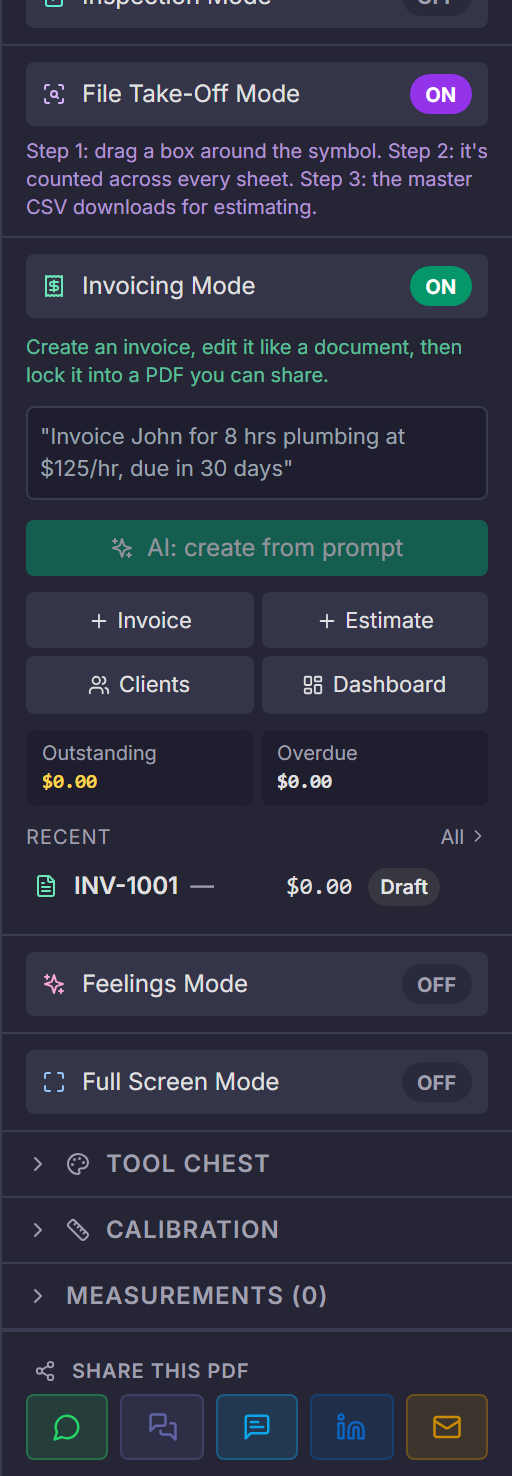
The workflow, step by step
A good takeoff follows the same path regardless of the software. First, calibrate: tell the tool what a known dimension on the sheet equals — a grid line, a scaled door, a dimension string. Second, measure: trace lengths, outline areas, drop counts on symbols. Third, verify: check the measurement list for outliers. Fourth, export: send the quantities to the estimate.
Every step depends on the first. A sheet calibrated to the wrong scale corrupts every downstream quantity — which is why modern takeoff tools treat calibration as a first-class, editable property of the page rather than a one-time setup dialog.
Measurement types that matter
Digital takeoff covers the full set of construction quantities: linear feet for pipe, conduit, wire, and base; square feet for flooring, drywall, roofing, and paint; cubic yards for concrete and excavation (area times a depth you set); and "each" counts for doors, fixtures, outlets, and equipment. Perimeter measurement handles trims and edges. A volume takeoff applies depth to an area to produce CY directly on the sheet.
AI-assisted takeoff
The biggest time saver is not faster clicking — it is not clicking at all. AI takeoff detects repeated symbols (a specific outlet, a fixture type, a column) and suggests counts across the sheet, which the estimator reviews instead of hunting. Magic-layer object detection goes further, lifting detected objects into countable, editable layers. For drawings scanned from paper, OCR finds the callouts and dimension strings first so nothing is missed.
From quantities to estimate
Quantities become a bid when they are exported and priced. PDFDepth exports the takeoff to Excel — type, label, quantity, unit, sheet — ready to drop into an estimating spreadsheet. For a multi-sheet set, the Master Takeoff Report aggregates quantities across every sheet in the folder, so a 40-sheet job produces one report instead of 40 exports.
| Type | Unit | Typical use |
|---|---|---|
| Distance / polyline | LF | Pipe, conduit, wire, base, fence |
| Area | SF | Flooring, drywall, roofing, paint, slab |
| Perimeter | LF | Trims, edges, formwork |
| Volume | CY | Concrete, excavation, fill |
| Count | EA | Doors, fixtures, outlets, equipment |
References
Everything in this article runs in the live PDFDepth workspace — the same app the workflows above were verified against.
Key takeaways
- Calibrate every sheet before measuring — one wrong scale corrupts everything.
- AI takeoff suggests counts; the estimator verifies and approves.
- Volume takeoff applies depth to a measured area for CY quantities.
- Excel export and the Master Takeoff Report feed the estimate directly.
Related questions
Yes. OCR reads the callouts and dimension text on a scanned sheet so measurement and symbol counts work the same way as on a vector PDF.
Do it in PDFDepth
In the app: Left panel → Tools → Measure, AI Tools → Takeoff
Try it free — no signup, no upload
Related articles
Put it into practice
Everything above runs inside the PDFDepth workspace — free for 14 days, no credit card.
Start for Free